3D Animal Vocabulary Game — Unity WebGL
A custom 3D vocabulary game built in Unity and exported to WebGL — showing two things eLearning procurement leads need before they sign off: an LMS course shell demo where the game sits beside real objectives, rubrics, and vocabulary rails; and a standalone player that loads only when the learner presses play.
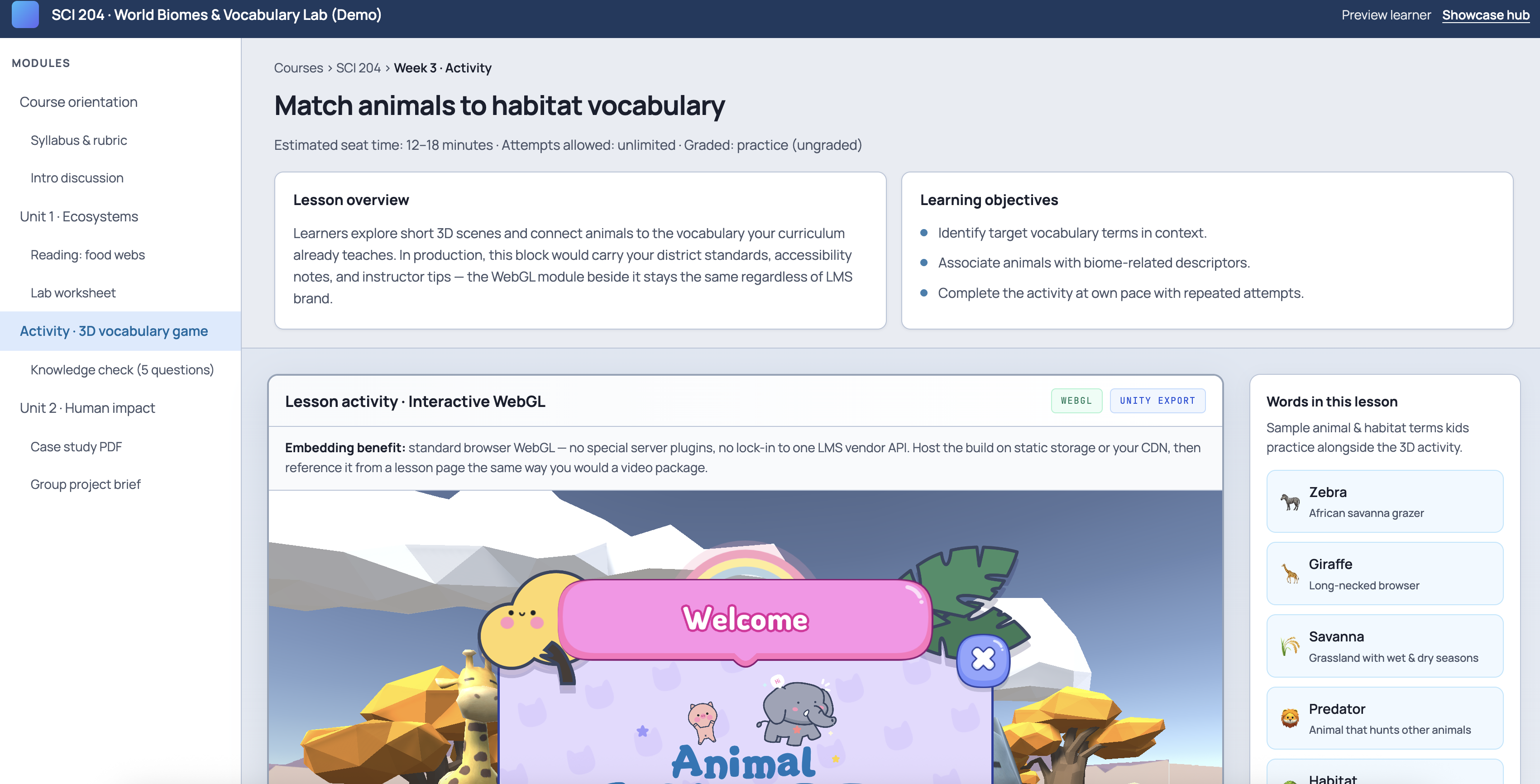
- No complex LMS integration — standard WebGL in any fixed canvas region
- Same pattern works in Canvas, Blackboard, Moodle, Cornerstone, or any custom stack
- Runtime is the browser, not a proprietary SDK
- Host lightweight standalone files on static storage or your CDN
- Custom build-and-embed service for teams that want retention without app-store friction
Standalone WebGL player
Loads only after you press play — same Unity files as the LMS mockup. Generic WebGL runs in modern browsers without locking you to one LMS vendor or tech stack.
A custom 3D vocabulary game built in Unity and exported to WebGL — which means no difficult tech setup on the LMS side beyond hosting static files and dropping in an iframe or lesson link. The output is not tied to one vendor API: if learners can open a normal course page in a modern browser, the same module sits beside your objectives, rubrics, and discussion prompts regardless of how the rest of the site was built.
Two formats, one build
- LMS course shell demo — a full-width illustrative course layout so curriculum and procurement stakeholders can judge fit-and-finish the same way they would for a video or SCORM block.
- Standalone WebGL player — deferred load behind a play control so course landing pages stay fast; mirrors how you would gate bandwidth behind "Start activity" in production.
Why WebGL is the right delivery format for eLearning games
Lightweight delivery: ship a self-contained build to static hosting (Netlify, S3, Azure Blob, your LMS CDN) and reference it like any other asset. Stack-agnostic: the integration surface is HTML + JavaScript + canvas — not a deep rewrite of your authentication, gradebook, or content model. Direct contractor relationship: I build vocabulary games, scenario drills, and interactive modules for K-12 publishers and eLearning teams. You work with me directly — short cycle, no agency markup, no account manager in between.
What I build for educational publishers
This game was built to the same spec I use on paid projects: the activity must run inside your existing LMS without a new vendor integration, without requiring your IT team to touch authentication, and without your instructional designers learning a new authoring tool. I've built educational 3D experiences for publishers including McGraw-Hill and am actively building K-1 vocabulary games for a major US K-12 publisher. The Unity-to-WebGL pipeline means you own the build, host it wherever you host everything else, and can update it without re-submitting to an app store.
Who this is built to persuade
K-12 and ESL publishers · world-language curriculum teams · eLearning procurement leads evaluating 3D modules · instructional designers who need to show stakeholders exactly where the activity lives · any buyer who has approved 3D on paper but cannot picture it beside their course outline.
When buyers can point at the exact rectangle where the activity lives in their LMS, the conversation stops being abstract — and abstract conversations do not get budget.
Need a WebGL learning module your LMS team will actually approve?
I build interactive 3D lessons, vocabulary games, and scenario-based training for product and learning teams — Unity or Three.js, embedded where your learners already work. Independent contractor, no agency overhead.