SHOWCASE
·
2026
·
Atmosphere Marketing · WebGL · Three.js
Living Aquarium — A Real-Time Interactive 3D Atmosphere You Can Sell Before the Space Exists
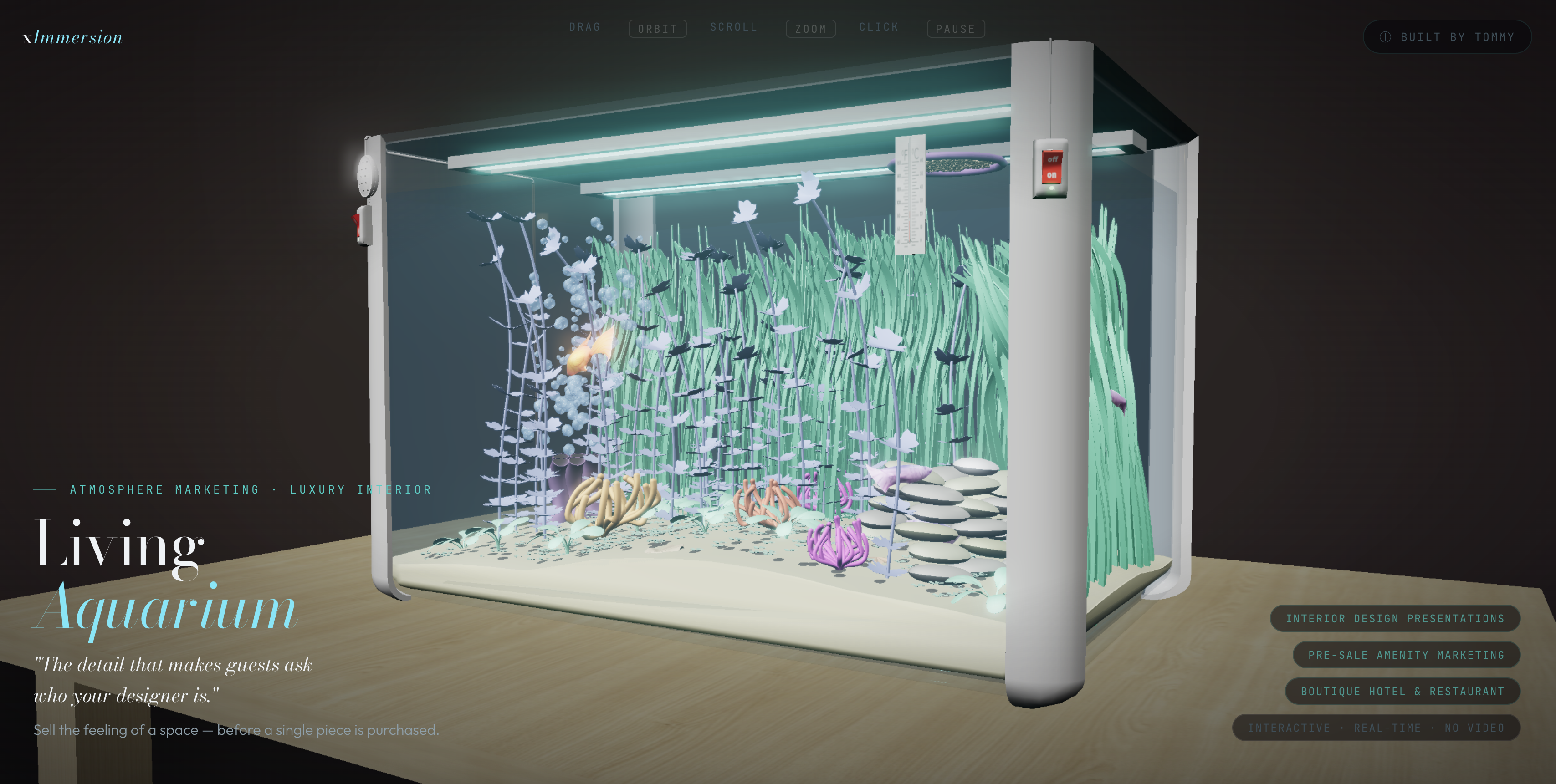
Some spaces are sold on square footage. The best ones are sold on a feeling. This interactive 3D aquarium environment lets interior designers, property developers, and boutique hospitality brands put a client inside the mood of a room — orbiting, zooming, watching the water move in real time — long before a single fixture is installed.
"The detail that makes guests ask who your designer is. Sell the feeling of a space — before a single piece is purchased."
— POSITIONING · ATMOSPHERE MARKETING FOR INTERIORS & HOSPITALITY
What This Experience Does
A custom real-time 3D ambient environment — built with Three.js and WebGL, running entirely in the browser, with no plugin, no app install, and no video file. Every fish, every bubble, every shift of light is rendered live on the visitor's own device, fully orbitable and interactive.
🐟
Real-Time Animated Scene — Not a Recording
Fish swim on skeletal animation and bubbles rise continuously, driven live by a single animation clip across hundreds of channels. The visitor orbits, zooms, and pauses the scene — something a video loop can never do.
💡
Atmosphere-First Lighting
The aquarium is the light source in the room — a warm pendant lamp, a teal glow inside the water volume, and animated caustic lights flickering across the surface. This is how you make a render feel like a place, not a product shot.
🎬
Cinematic Post-Processing
Unreal-style bloom, filmic tone mapping, depth fog, and a vignette give the scene the soft, premium glow of a high-end interior photograph — at 60fps, generated in real time rather than baked into a clip.
🪑
Built to Be Rebranded to Your Space
The aquarium is a demonstration. The same engine wraps your furniture, your materials, your lighting, your floor plan — delivered as a single shareable link that drops into a pitch deck, a listing page, or a sales-suite display.
Who This Is Built For
Five buyer personas — each with a commercial reason to put an interactive 3D atmosphere in front of a client. Any one of them can approve a project like this without procurement review at the price point it's designed for.
Interior Designer
Mood boards and flat renders don't transmit how a space feels. Clients hesitate, ask for revisions, and stall on sign-off because they can't picture the room.
"I sent a link. They orbited the room, felt it, and approved the concept the same day."
Property Developer
Pre-sales happen before the building exists. Static brochures of "lifestyle amenities" don't move buyers off the fence on an off-plan unit.
"Buyers experienced the lobby and amenity floor in 3D before we broke ground. The atmosphere did the selling."
Boutique Hotel / Restaurant
Atmosphere IS the product — but it's invisible online. A photo of an empty room can't convey the mood guests are actually paying for.
"The 3D scene on our site is the reason people DM us asking who designed the room."
Marketing / Brand Lead
Needs differentiated content that isn't another video or carousel. Stock 3D looks generic; bespoke film shoots are slow and expensive.
"An interactive scene people actually play with — for a fraction of what a video shoot would have cost."
Real Estate / Sales Suite
Walk-in clients need to feel the unit on a screen in the sales gallery. Flythrough videos play once and end; nobody interacts with them.
"Deployed an interactive 3D amenity environment on the sales-suite touchscreen. Visitors stayed with it — and remembered it."
What Selling Atmosphere Costs Without This
The alternatives to a real-time interactive scene are slower, more expensive, and less memorable. Here's what they actually cost.
$15K+
A single professional CGI flythrough video — and it plays once, then it's over
Weeks
Render-farm turnaround for one polished animation — every revision restarts the clock
0 sec
How long a static render holds attention — buyers scroll past flat images in a heartbeat
1 link
One interactive scene replaces the video shoot, the render farm, and the brochure render — and unlike all of them, the client can pick it up, orbit it, and explore it themselves. Interactive beats passive every time attention is the goal.
Why Real-Time 3D Beats a Render or a Video
- People remember what they touch. A flythrough video is watched and forgotten. An interactive scene the client orbits themselves creates an emotional, hands-on memory of the space.
- Atmosphere is spatial, not flat. You can't feel a room from one camera angle. Real-time orbit lets a client find the angle that sells them — the one your fixed render never showed.
- Revisions don't restart a render queue. Change a material, a light, or a layout and it updates live. No farm, no overnight wait, no per-frame re-render bill.
- It loads anywhere, instantly. One link. No plugin, no app, no download — it runs in any modern browser, on the client's phone, in your pitch deck, or on the sales-suite screen.
- Your competitors are still sending PDFs and MP4s. Put an interactive 3D atmosphere in front of a client and it's the only thing from the meeting they'll still be talking about a week later.
How It's Built — The Technical Detail
Every element of this scene is real-time and engineered for the look, not faked with a video. Here's what's actually running in the browser.
EngineThree.js r160 · WebGL 2
Lighting modelPBR + image-based environment (PMREM)
Post-processingUnrealBloom · ACES filmic tone mapping
AtmosphereExponential depth fog · custom gradient sky sphere
ShadowsReal-time PCF soft shadows
Frame rate60 fps target on mid-range mobile
AssetSingle optimized GLB scene
AnimationSkeletal fish + rising bubbles, one clip · 300+ channels
Live water glowInterior teal point light + 3 animated caustics
Material passesPer-material tuning: water, glass, neon, coral, sand
Custom motionProcedural sway on coral, algae & plants
ControlsOrbit · zoom · click-to-pause · auto-rotate
What Clients Provide · What You Get Back
Built for department-level purchase authority — under the $15K threshold, no procurement screening, roughly 2–3 weeks from brief to delivery.
| Client Provides |
You Receive |
Format |
| Reference images or moodboard |
The look, palette, and mood translated into a 3D scene |
JPG / PDF / Pinterest |
| Floor plan or room layout |
Accurate spatial proportions and camera framing |
PDF / DWG / sketch |
| Key furnishings / hero objects |
Your signature pieces modeled or placed in the scene |
Product list / spec |
| Lighting intent |
Warm/cool mood, accent glow, time-of-day feel |
Simple brief |
| Brand colors / logo (optional) |
Branded scene wrapper, title card, contact CTA |
Style guide |
Interactive 3D atmosphere sceneStandalone web page
Real-time animation & lightingIncluded
Orbit / zoom / pause controlsIncluded
Branded title card & CTAIncluded
Embeddable in site / deck / kioskiframe or full-page link
Hosting requirementAny web server or CDN — no backend
Browser compatibilityChrome, Safari, Firefox, Edge — WebGL 2
Mobile supportFully responsive — tested on iOS and Android
Price range$6,500 – $9,500 per project
Delivery timeline2–3 weeks from brief
What It Took to Build
A focused build on a real GLB scene, hand-tuned for atmosphere. Not a stock asset dropped into a viewer — every material, light, and motion was authored for the feeling.
- Per-material passes — water, glass, neon lamp, coral, algae, and sand each get their own transparency, emission, and roughness tuning so the scene reads as a place, not a model dump.
- Single-clip animation driving the whole scene — fish bones and bubble motion run from one clip across hundreds of channels, keeping the file lean and the motion continuous.
- The aquarium is the light source — interior teal glow plus three animated caustic lights flickering across the water, with a warm pendant lamp for the "night-time luxury interior" mood.
- Custom gradient sky sphere — a shader-driven backdrop that can never clip or pop during orbit, unlike flat wall planes.
- Real-time, standalone, shareable — runs at 60fps in any modern browser as a single link; drops straight into a pitch deck, a listing page, or a sales-suite touchscreen.