Interactive 3D Safe Patient Handling Training Module
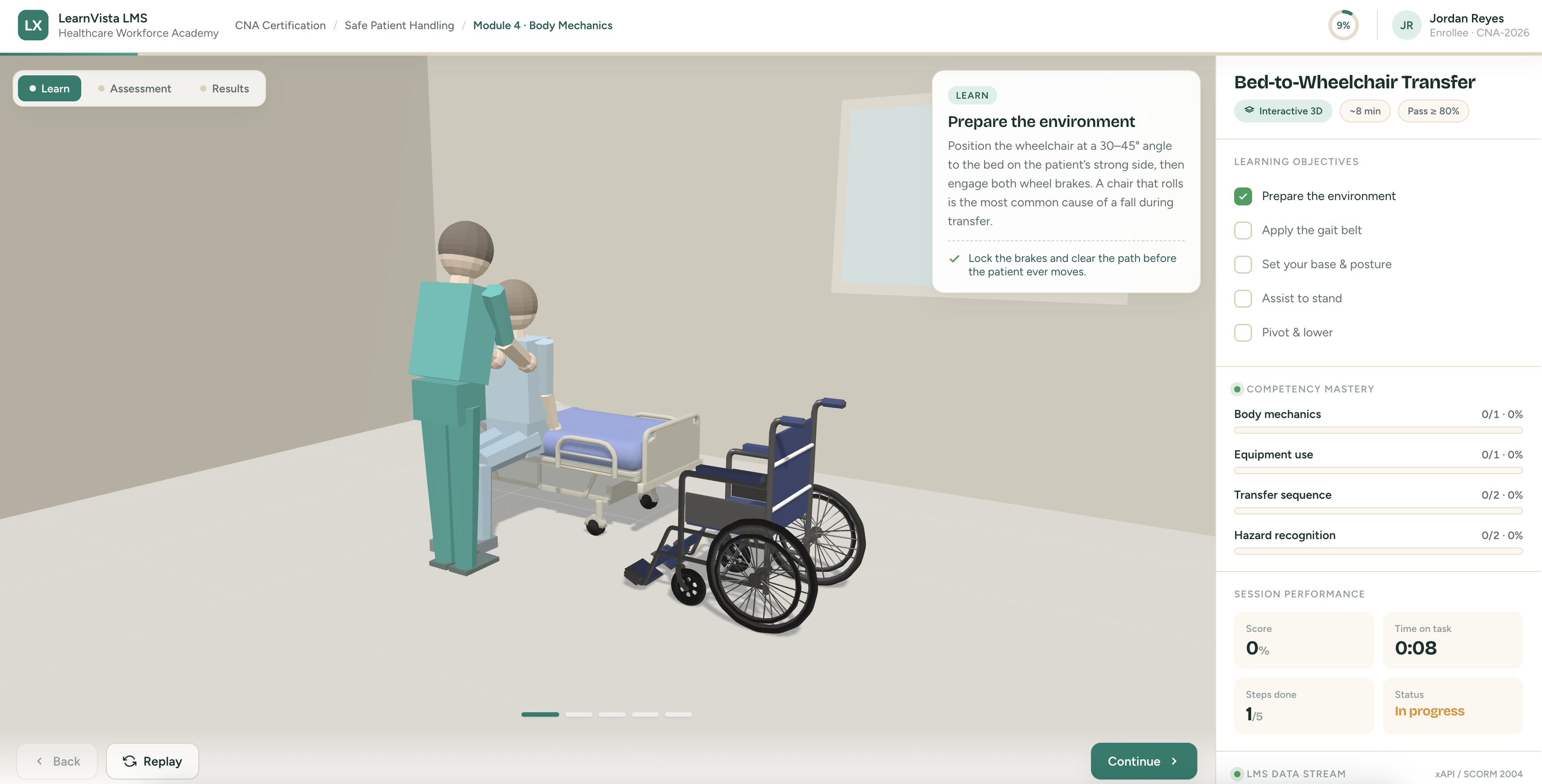
Learn mode · Body mechanics assessment · 6-question hazard & sequence test · xAPI score report
EXPLORE MODULE ↗Your CNA students watch the safe patient handling compliance video on mute, click through every slide of the body mechanics module, and walk out the first week and injure their back on a real bed-to-wheelchair transfer. Workers' comp claims, OSHA recordables, staff turnover. This interactive 3D safe patient handling training module replaces passive nursing assistant compliance video with hands-on scenario-based competency assessment — and reports completion, score, and xAPI verb back to HealthStream, Relias, Cornerstone, or any healthcare LMS automatically.
"Forty new CNAs completed the safe patient handling competency on their phones during onboarding week. Average score: 88%. Zero room bookings, zero classroom hours, full LMS audit trail."
What the interactive 3D safe patient handling training module covers
- Learn mode — guided bed-to-wheelchair transfer walkthrough — five teaching beats (prepare the environment and engage wheelchair brakes, apply the gait belt, set a stable base and neutral spine, assist the patient to stand, pivot and lower in small steps) with 3D-rendered patient, caregiver, hospital bed and wheelchair. Each step locks the camera onto the relevant body mechanic and shows the principle being applied, building procedural memory that a static body mechanics slide deck simply cannot.
- Six-question competency assessment with 3D-rendered consequence — hazard recognition (unlocked wheelchair brakes, improper lifting posture), body mechanics (where the power comes from in a transfer — back, arms, or legs), transfer sequence (what must be completed before assisting to stand), and equipment use (correct gait belt application). Each question renders the situation in 3D so the learner is making a decision under visual context, not picking a label off a multiple-choice list.
- Bend-versus-lift posture comparison — the assessment scenarios contrast a caregiver bending at the waist (loading the lumbar spine — the leading cause of caregiver musculoskeletal injury in the United States) against a caregiver squatting with bent knees and a neutral spine. The 3D visual difference is unambiguous; the learner remembers it because they saw it, not because they read it.
- SCORM, xAPI and cmi5-compatible score reporting — competency-weighted pass/fail score across body mechanics, equipment use, transfer sequence and hazard recognition; 80% pass threshold; per-competency performance breakdown; visible xAPI data stream (lesson_status, score.scaled, success_status, completion_status) that drops directly into HealthStream, Relias Learning, Cornerstone OnDemand, Docebo, Absorb LMS, TalentLMS or any LRS without per-seat license renewal.
- Real GLB hospital-bed and wheelchair assets — production-quality stylized low-poly equipment, not abstract blocks. Recognisable to any CNA, RN, home health aide, or personal care worker who has done a real transfer in their first clinical week.
- Mobile-first and tablet-first delivery — works on the same phones and tablets your staff are already issued. No new app to deploy, no IT procurement cycle, no per-seat license. Drops into your existing LMS or runs as a standalone certification-week module.
Who commissions a custom medical training module like this — and why they approve it immediately
Director of Nursing (DON) and Chief Nursing Officer (CNO) at hospitals, skilled nursing facilities, long-term care, home health agencies, and continuing-care retirement communities are accountable for nurse and CNA competency, workplace safety, patient-fall reduction, and the safe patient handling and mobility (SPHM) program required under TJC and CMS Conditions of Participation. A measurable, scored, audit-ready training record per employee — delivered without the scheduling overhead of skills-lab classroom hours — moves multiple KPIs at once.
Clinical Education Manager, Staff Development Coordinator and Workforce Training Director are measured on completion rate and knowledge retention. Passive video gets 100% click-through and 0% behavioural change. A 3D scenario-based assessment that requires hazard recognition under visual consequence produces measurable retention outcomes — and the xAPI trail is the audit evidence the surveyor wants when they walk in.
CNA Program Director, Nursing Instructor and Clinical Preceptor at community colleges, vocational schools, healthcare workforce academies, and hospital-based CNA programs need consistent, repeatable, evidence-based delivery of body mechanics, patient transfer, and hazard recognition content. A 3D interactive module standardises the teach — every cohort gets identical instruction, identical assessment, identical scoring — and the program director gets a per-student competency matrix instead of a stack of paper checklists.
HSE Manager, Patient Safety Officer and Risk Manager need documented OSHA-aligned and Joint Commission-aligned safe patient handling training for every direct-care employee, annually. A browser-based module that scores, reports, and logs completion per learner eliminates scheduling overhead and paper records — and produces the documented training paper trail that survives an OSHA 1910 General Duty Clause citation review or a TJC tracer.
Home Health Agency Director, Personal Care Worker Trainer and Long-Term Care Administrator need to onboard high-turnover workforces fast, on mobile, without a classroom. A 5–8 minute interactive module that delivers a competency score and an LMS-reportable completion record per worker is exactly the gap off-the-shelf SCORM healthcare libraries leave wide open.
Continuing Education (CE) and CEU Course Developer for state nursing boards, BRN-approved providers, and ANCC-accredited continuing-nursing-education organisations need engaging, completion-trackable content for license renewal hours. A 3D interactive case is a substantially stronger CEU artifact than a PDF and a Likert-scale survey.
Why a custom interactive 3D module outperforms off-the-shelf SCORM healthcare training packages
Generic SCORM body mechanics packages show a photograph of a CNA lifting a patient and ask "which posture is correct?" with four radio buttons. The answer is identical every session. Trainees memorise the label, not the reasoning. Consequence-free multiple-choice produces zero behavioural change, zero retention at 90 days, and zero measurable reduction in caregiver back injury claims.
This module shows the wrong answer's consequence in 3D — the bent-spine lifting posture is rendered alongside the correct squat-and-lift, side by side; the learner sees the difference, not just reads about it. Combined with no per-seat license fee, no annual SaaS renewal, and no LMS lock-in for deployment, it delivers better safety outcomes at a lower total cost of ownership than any off-the-shelf nursing-education library.
It is built specifically for healthcare workforce training — CNA certification programs, RN orientation, home health aide onboarding, personal care worker certification, nursing assistant continuing education, hospital-based annual SPHM recertification, long-term care competency assessment, and clinical educator-led skills-lab augmentation — not retrofitted from a generic corporate compliance library.
Search terms this addresses
Interactive 3D medical training module, safe patient handling training, safe patient handling and mobility (SPHM), safe patient handling and movement, bed-to-wheelchair transfer training, nursing assistant body mechanics training, CNA certification training module, CNA body mechanics eLearning, patient transfer competency assessment, healthcare body mechanics simulation, OSHA safe patient handling guidance, NIOSH patient handling training, Joint Commission patient safety training, AAOHN ergonomics in healthcare, ANA Safe Patient Handling and Mobility Standards, VA National Safe Patient Handling Movement Program, musculoskeletal injury prevention training for caregivers, workplace injury prevention healthcare, browser-based nursing eLearning module, WebGL medical training simulation, Three.js healthcare training, custom SCORM healthcare module, xAPI healthcare LMS, cmi5 nursing education, HealthStream-compatible CNA training, Relias Learning-compatible body mechanics module, Cornerstone OnDemand healthcare training, Docebo nursing LMS content, Absorb LMS healthcare eLearning, mobile-first CNA training, tablet-based nursing assistant training, home health aide training module, personal care worker training simulation, long-term care staff training, skilled nursing facility competency assessment, continuing-care retirement community workforce training, hospital onboarding 3D module, RN orientation interactive content, nursing instructor curriculum technology, clinical preceptor digital tool, CEU 3D case study, BRN-approved continuing nursing education, ANCC-accredited interactive content, healthcare workforce academy training, nurse aide registry preparation, state-tested nursing assistant (STNA) training, Medication Aide training module, patient handling program (PHP) software, SPHM coordinator toolkit, safe patient handling coach training, ergonomics-in-nursing module, lift team training, manual handling training healthcare UK, manutention patient training, no-lift policy training, zero-lift policy module, Hoyer lift training, sit-to-stand lift training, gait belt training, transfer board training, slide sheet training, caregiver coaching, workforce competency software healthcare, just-in-time training healthcare, microlearning nursing, spaced repetition clinical education, behavioural skill acquisition CNA, knowledge retention nursing assistant.
What it took to build
One focused development cycle. Procedural Three.js characters for caregiver and patient (so they articulate per phase — bent-wrong vs lifted-right), real GLB hospital-bed and wheelchair assets, a 6-question competency assessment with weighted scoring across four healthcare competencies, an embedded LMS course-shell wrapper showing live competency mastery and an xAPI / SCORM 2004 data stream — single standalone HTML, loads on every device, no SaaS dependency. Adapted to a client's specific facility equipment, gait belt brand, lift devices, transfer surfaces, patient demographics and brand in 1–2 weeks.
Price range: $8,000–$14,000 per module · Below the $15K department approval threshold · No procurement screening required · Open the live module →