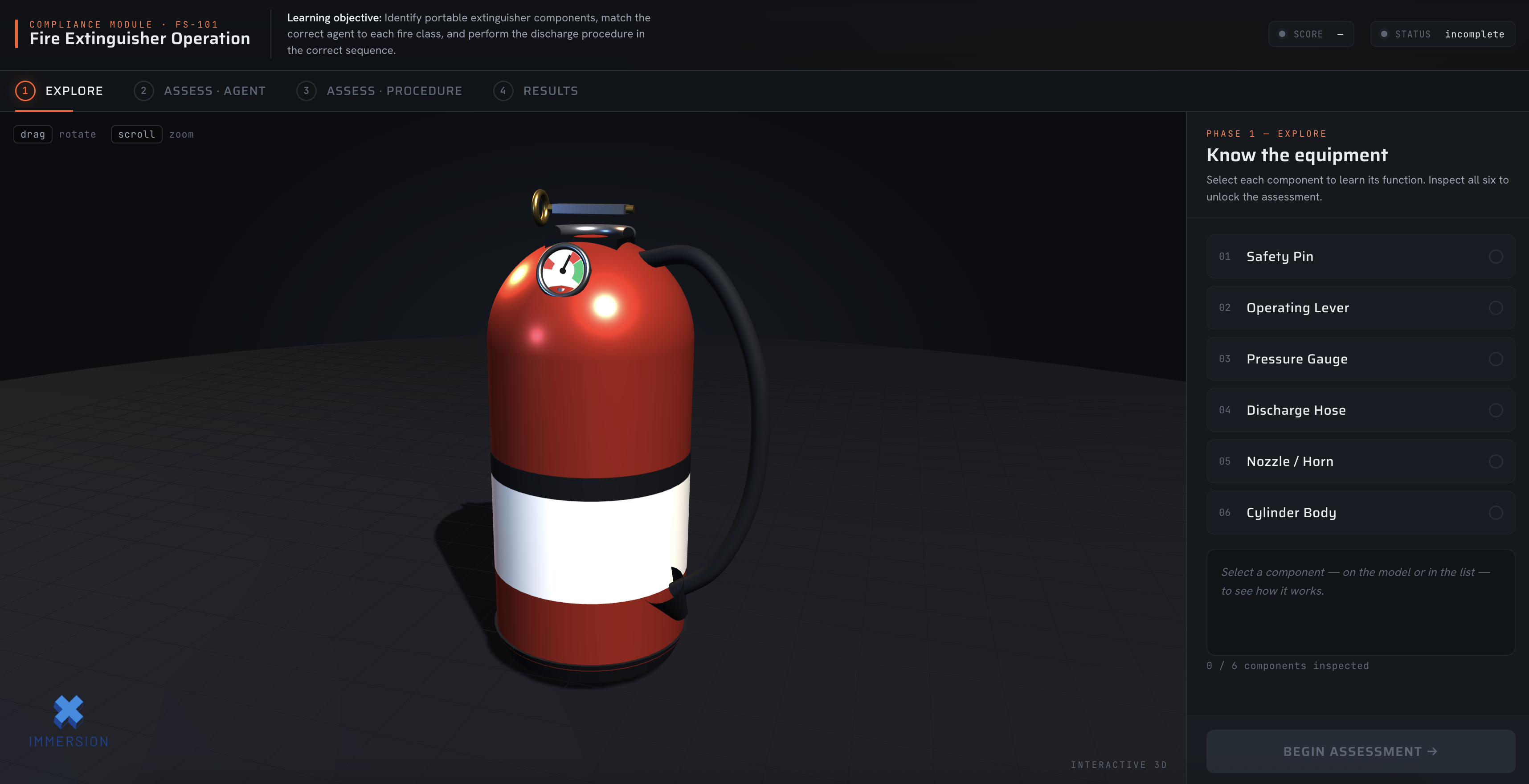
Your employees watch the fire safety compliance video on mute, click through every slide, and walk out knowing nothing. The first real fire costs six figures in liability — and no retroactive training log can undo a fatality. This interactive 3D fire safety training module replaces passive compliance video with hands-on, scenario-based assessment that creates genuine behavioural change — and reports completion, score, and xAPI verb back to any LMS automatically.
Hi — I'm Tommy. I built this interactive 3D fire safety training module in a focused day to show corporate L&D teams and HSE managers what a browser-based eLearning module actually looks like when it's built properly. Explore mode, drag-and-drop fire class agent assessment with 3D consequence feedback, PASS technique procedure sequencing — all working code, ready to be adapted to your specific hazards, your workplace equipment, and your annual compliance calendar. For a fraction of what your last off-the-shelf SCORM package cost.
"They completed the fire safety recertification on mobile during lunch. Score: 94%. No room booking, no projector, no presenter — just a link."
What the interactive fire safety training module covers
- Phase 1 — Explore: interactive fire extinguisher component identification Six clickable parts (safety pin, operating lever, pressure gauge, discharge hose, nozzle/horn, cylinder body) each with an educational callout explaining function, inspection criteria, and failure modes aligned with NFPA 10 standards. All six components must be inspected before the assessment phase unlocks — a gating mechanic that enforces active engagement over passive click-through and ensures knowledge coverage before any scored assessment begins.
- Phase 2 — Assess: drag-and-drop fire class agent matching with 3D consequence feedback Three realistic workplace fire scenarios rendered in 3D: Class A ordinary combustibles (waste bin), Class C live electrical equipment (server rack), and Class K cooking oil fire (commercial fryer). The learner drags the correct suppression agent onto each scenario. Wrong choices trigger visible 3D consequence: water on burning cooking oil causes a violent flare-up and danger flash; CO₂ on live electrical equipment is confirmed correct and safe. Not a radio-button quiz — a drag-and-drop decision under visual consequence that creates genuine scenario memory and transfers to real behaviour.
- Phase 3 — Assess: PASS technique procedure sequencing The four-step discharge sequence (Pull · Aim · Squeeze · Sweep) as a drag-and-drop ordering exercise. Correct sequence triggers the 3D fire extinguisher to animate the full PASS procedure in real time. Incorrect answers allow rearrangement without hard failure states; a skip option ensures no learner is ever permanently blocked. Slot removal by tapping a filled position allows re-ordering, teaching deliberate self-correction — not just guessing.
- Results and xAPI-compatible score reporting Weighted pass/fail score (agent selection 60%, PASS technique sequencing 40%), 80% pass threshold, per-section performance breakdown, and a visible xAPI tracking payload (cmi.core.lesson_status, cmi.core.score.raw, xAPI completion verb) that maps directly to Rustici Engine, SCORM Cloud, Cornerstone, Workday Learning, SAP Litmos, Moodle, and any other xAPI-compliant LMS without a custom integration layer.
Who commissions this browser-based fire safety training module
L&D Director is measured on completion rate and demonstrable knowledge retention. Passive compliance video achieves 100% click-through completion and near-zero behavioural change. An interactive 3D safety module that requires active drag-and-drop decision-making under visual consequence produces measurable retention outcomes — and the per-learner xAPI trail is audit evidence that survives any compliance review.
HSE Manager needs documented OSHA-compliant fire safety training completed by every employee, every year. A browser-based module that scores, reports, and logs completion per learner eliminates room-booking overhead, presenter dependency, and paper records — without triggering a new software procurement cycle.
EHS Officer and Risk Manager need the training paper trail to survive an OSHA 1910.157 citation review or an insurance audit. A graded, timestamped xAPI record per employee is the most defensible evidence available. One OSHA serious citation for inadequate portable fire extinguisher training is $15,625. This module costs less than that.
Corporate Safety Trainer spends 30% of their week scheduling rooms, chasing completions, and presenting content that was outdated before it was printed. This module runs on every device, tracks itself, and updates content without a reprint or a rerun cycle. They stop being a logistics coordinator and start being a safety strategist.
Why this interactive 3D module outperforms off-the-shelf SCORM fire safety packages
Generic SCORM fire safety packages present a photograph of a fire and ask "which extinguisher class applies?" with four radio buttons. The answer is identical every session. Employees memorise the label, not the reasoning. Consequence-free multiple-choice produces zero behavioural change and zero real-world preparedness — they've learned to complete a quiz, not to respond to a fire.
This module shows the wrong answer's physical consequence in 3D: water on burning cooking oil produces a violent flare-up, CO₂ on live electrical equipment removes the electrocution risk. The learner experiences the outcome rather than selecting a label. That difference — between knowing an answer and understanding a consequence — is the difference between a training record and a trained employee.
Additionally: no per-seat licence fee, no annual SaaS renewal, no LMS infrastructure dependency for deployment. One standalone HTML file, under 80 KB, delivers the full module from any static server, corporate intranet, or LMS iframe. Zero external dependencies at runtime.
Workplace fire safety compliance alignment — OSHA, NFPA, and UK Fire Safety Order
The module content is aligned with OSHA 29 CFR 1910.157 (portable fire extinguisher training requirements for fixed workplaces), NFPA 10 (standard for portable fire extinguishers — inspection, maintenance, testing, and operational procedures), and UK Fire Safety Order 2005 (Article 21 — employee fire safety training obligations for responsible persons).
Fire class designations follow NFPA/OSHA classification: Class A (ordinary combustibles — wood, paper, cloth), Class C (energised electrical equipment), Class K (cooking oils and fats in commercial cooking equipment). The PASS discharge technique sequence (Pull · Aim · Squeeze · Sweep) follows NFPA 10 and OSHA-approved training procedure guidance verbatim. Fire agent type guidance (water for Class A, CO₂ for Class C, wet chemical for Class K) is factually accurate to NFPA classifications and standard workplace fire safety practice.
Gamified fire safety training that builds genuine competency
The term gamified compliance training is widely misused — it usually means adding a badge to a slide deck. This module applies genuine instructional design principles: observable consequence for wrong decisions, deliberate practice of the actual procedure, gated progression that ensures content coverage before assessment, and a scoring model that reflects weighted competency rather than raw correct-answer count.
The result is an annual fire safety recertification module that employees actually engage with, remember after the session ends, and can apply under real-world pressure — rather than a compliance checkbox that generates a completion log and nothing else.
Technical build — deployment, integration, and customisation for any workplace
Single standalone HTML file, under 80 KB (excluding thumbnail image), loads in under 2 seconds on standard broadband. Fully procedural Three.js — 3D fire extinguisher model, animated flame particle system, CO₂ discharge particles, drag-and-drop interaction layer, PASS animation choreography — no GLB files, no CDN assets, no runtime dependencies beyond Three.js r128 from a public CDN.
Fully mobile responsive with tap-to-place interaction fallback: all drag-and-drop assessment interactions are also completable by tap, without separate mobile code paths. The module renders correctly on iOS Safari, Chrome Android, and all major desktop browsers. Custom orbit control replaces OrbitControls for zero additional dependency.
Adapted to a client's specific workplace hazards, equipment types, regulatory jurisdiction (OSHA, HSE, Safe Work Australia, etc.), brand language, and LMS infrastructure in 1–2 weeks. Custom fire scenarios, custom equipment models, custom agent sets, custom pass thresholds, and custom xAPI actor/verb configuration are all standard adaptation scope.