Your buyers don't hesitate because your product is wrong for them. They hesitate because they can't tell whether it's right. Specs, datasheets, and static product photos can't answer the question that actually matters: "Will this perform the way you say in my specific operating conditions?"
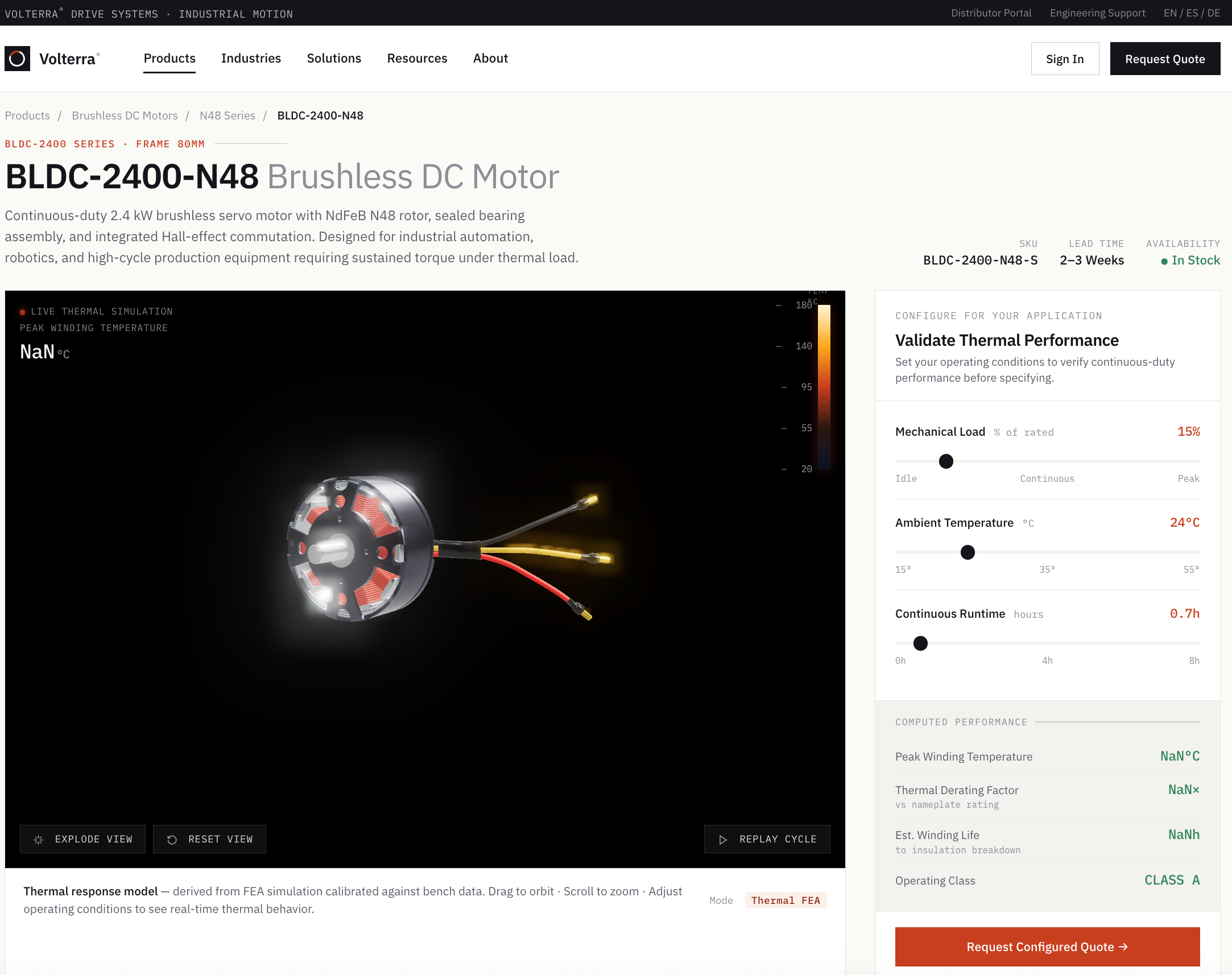
This demo answers that question. It is a fully-contextual industrial product page for a fictional brushless DC motor — wrapped in a convincing manufacturer site (Volterra Drive Systems) so prospects immediately see how the experience would slot into their own product catalog. The buyer sets load, ambient temperature, and runtime. The motor responds in real time: copper windings glow first, stator iron warms next, the aluminum housing radiates slowly outward. Computed performance stats — winding temperature, derating factor, estimated life, insulation class — shift live alongside the visuals.
A configurator that shows consequence, not just color. That's what closes the deal.
What buyers actually see
The demo is built around the moment of hesitation that every industrial B2B buyer faces — the gap between specs on paper and confidence in their application. Instead of forcing them to email sales for a configured datasheet, they self-qualify in 90 seconds.
- Three operating sliders — mechanical load, ambient temperature, continuous runtime — covering the variables every engineer thinks about
- Per-component thermal response — windings heat first, housing last, exactly the way a real motor behaves under load
- Live performance readouts — peak winding temperature, thermal derating factor, estimated insulation life, operating class — all updating in real time
- Animated exploded view — reveals the internal structure with one click, so buyers see exactly which component is heating up and why
- Auto-running welcome cycle — even passive visitors who don't touch the controls see the full thermal story play out in under 11 seconds
- Convincing product-page wrapper — breadcrumbs, SKU, spec tables, footer — so the buyer immediately imagines this living on their own catalog
Why this can't be done with off-the-shelf SaaS
Generic 3D product configurators — the kind sold by subscription — handle material swaps, color variants, and basic explode views. They do not, and structurally cannot, show consequence. They cannot connect a slider input to a physics-based shader response. They cannot weight thermal behavior differently for copper versus aluminum. They cannot make the engineering truth of your product visible.
This demo does what no templated configurator does:
- Custom GPU shader injection per material — each component has its own heat response curve
- Real-time uniforms driven by user input, with smoothing that mimics thermal mass
- Bloom post-processing tied to thermal threshold — the windings literally glow when they overheat
- Computed engineering outputs (derating, Arrhenius-style life estimates) that update alongside the visuals
- Built directly into your existing product page — no iframe, no SaaS subscription, no brand dilution
Industries where this fits naturally
This demo is intentionally generic in subject (a brushless DC motor) but the pattern transfers to any physical product where invisible performance behavior drives the buying decision. If your customers ask "will it overheat?", "will it deform?", "will it leak?", "will it fail?" — they are asking the question this kind of demo answers.
- Industrial motor manufacturers
- HVAC & cooling system OEMs
- EV component & battery system suppliers
- Industrial automation distributors
- Robotics & motion control companies
- Heavy machinery OEMs
- Medical device manufacturers
- Aerospace component suppliers
- Power electronics & inverter companies
- Energy storage & grid-tied systems
- Hydraulic & pneumatic equipment
- Precision machined components
Performance, weight, and integration
Industrial B2B buyers visit product pages on whatever device is in front of them — desktop at their workstation, tablet on the floor, phone in a procurement meeting. The demo is built to load fast and run smoothly on all of them.
- Under 6 MB total payload — the entire 3D model, textures, and runtime libraries
- Loads in under 2.5 seconds on a typical 4G mobile connection
- 60 fps on mid-range mobile — including post-processing bloom
- Integrates as a single HTML drop-in — works inside any CMS, framework, or static site
- No subscription, no vendor lock-in — you own the code and the experience
- CAD-pipeline compatible — accepts CAD exports from Autodesk Inventor, SolidWorks, Fusion 360, and Onshape via standard GLB/glTF conversion
The configuration-to-quote pipeline
The most underrated effect of this kind of demo isn't the visual impact — it's what happens to your sales pipeline. When a buyer arrives at "Request Configured Quote" they bring their full operating context with them. No more three rounds of email to nail down ambient temperature and duty cycle. No more sales-engineering meetings to discover the application isn't a fit. The buyer self-qualifies, and the lead arrives pre-scoped.
The buyer doesn't reach out to sales until they already believe the product fits. That changes everything about the conversation.
What it took to build
Roughly one focused day of custom development. The 3D model is a single GLB file (5.7 MB). The runtime is pure WebGL via Three.js. The thermal shader is custom GLSL injected per material. The contextual wrapper — the manufacturer's product page chrome — is hand-coded HTML and CSS designed to look like a real industrial catalog entry rather than a portfolio piece.
The point isn't the technology. The point is that this kind of experience is achievable without an agency retainer, without a multi-month engagement, and without a team. For most industrial product manufacturers, one of these — built once, deployed across the catalog template — is enough to differentiate every product page from every competitor's static catalog.