Immersive 3D Virtual Gallery
A browser-based interactive 3D virtual exhibition space built with Three.js and WebGL — four layout samples showing how immersive digital galleries embed into real websites, from full-page experiences to seamless in-context modules.
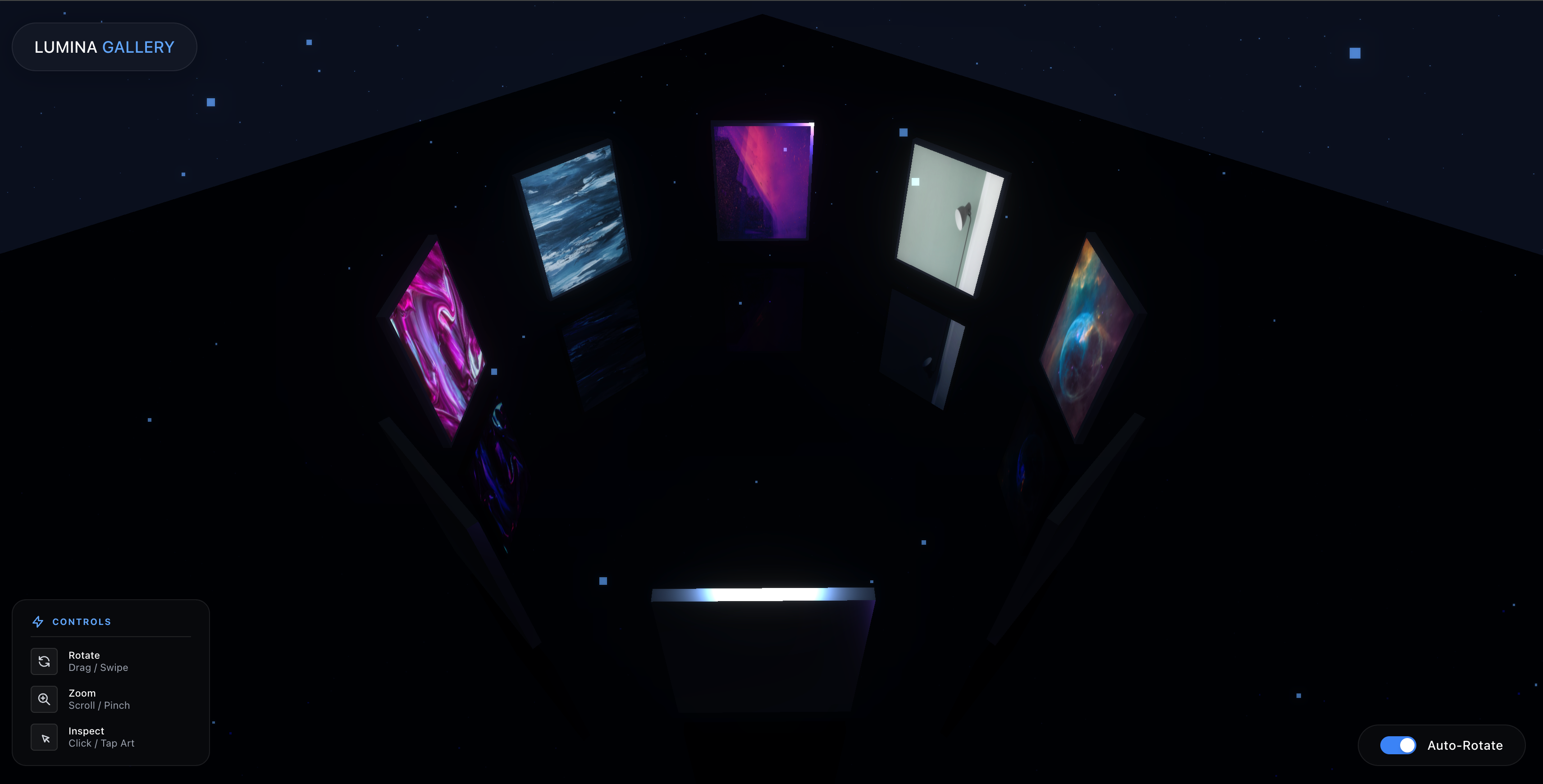 Full Page
Full Page Immersive Experience
The complete standalone 3D gallery — auto-rotating exhibit with clickable artworks, reflective floor, bloom lighting, and cinematic camera entrance.
Open demo ↗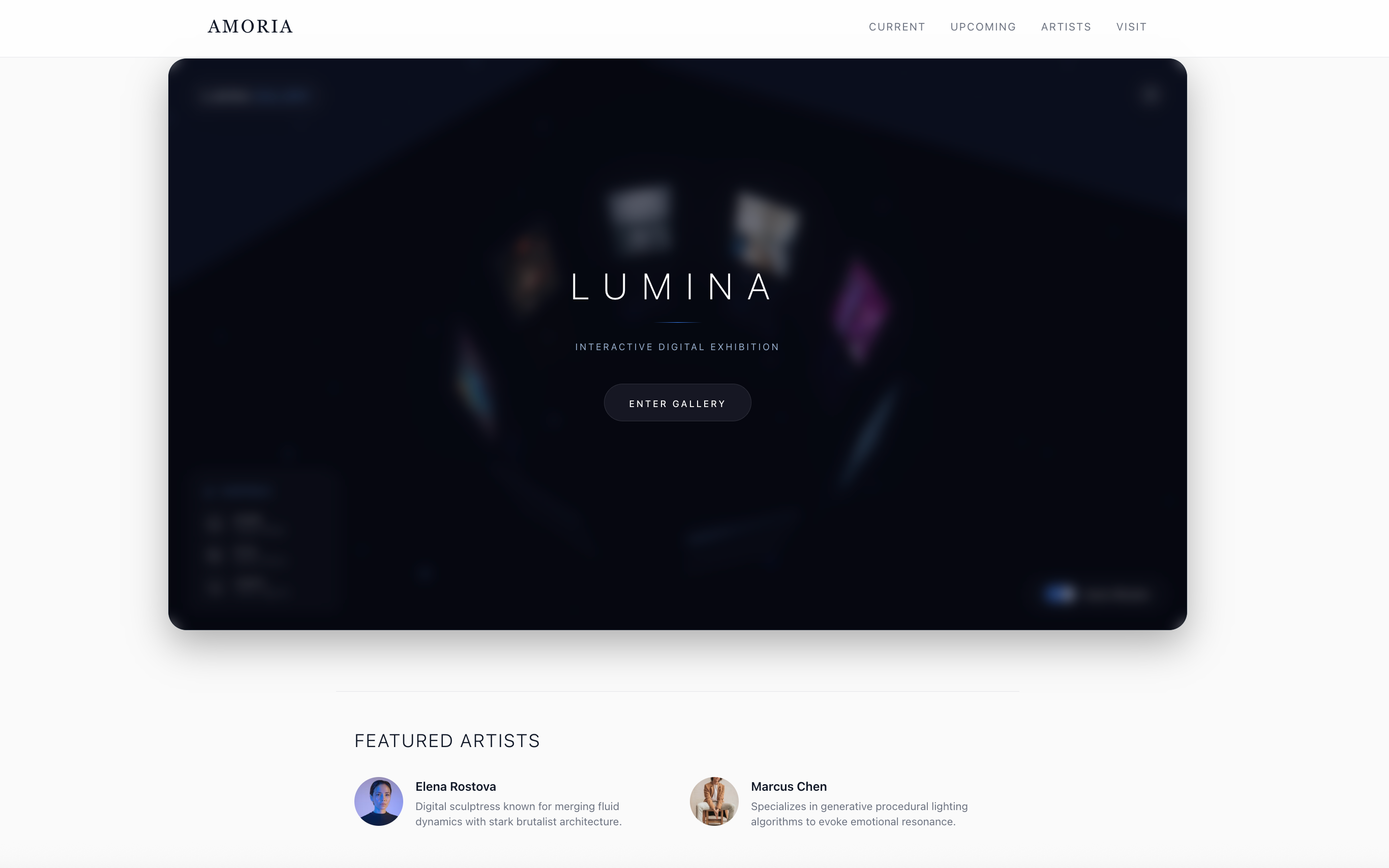
Contextual Webpage Showcase I
Shows how the 3D gallery module integrates into an existing brand website — real navigation, hero section, and content surrounding the interactive exhibit.
Open demo ↗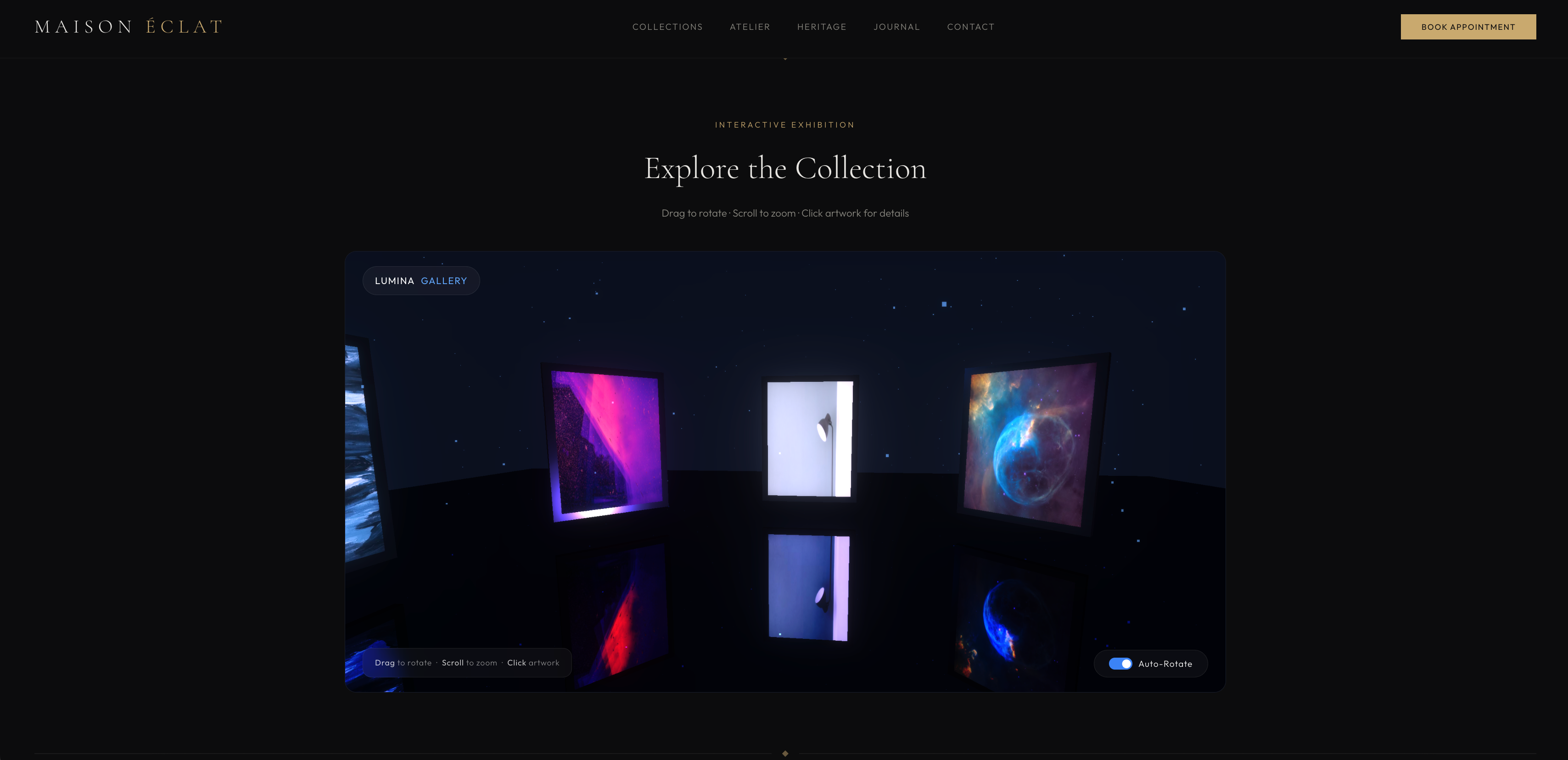
Contextual Webpage Showcase II
Same integration concept, different brand identity — proves the gallery adapts to any design system and visual style.
Open demo ↗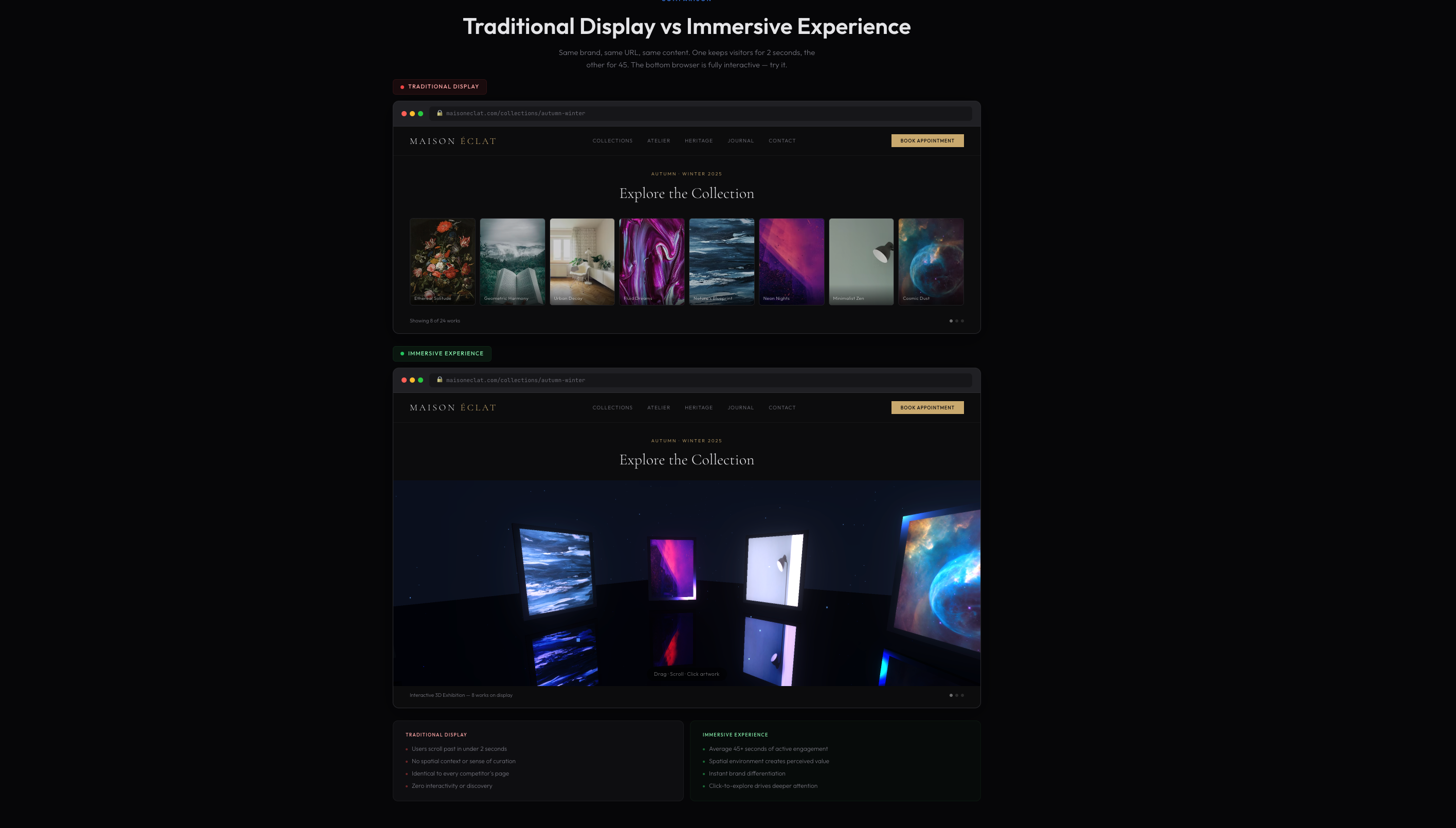 Comparison
Traditional vs Immersive
Stacked browser windows, same brand — flat image row on top, interactive 3D gallery below. Same URL, fundamentally different experience.
Open demo ↗This is an original interactive 3D virtual gallery built entirely in the browser with Three.js and WebGL. Eight artworks float in a circular exhibit with auto-rotation, click-to-inspect detail modals, a reflective floor surface, Unreal bloom post-processing, and ambient particle effects — all running at 60fps on desktop and mobile with no plugins, downloads, or app stores.
The four layout samples above aren't just different ways to view the same demo. They answer the four most common questions potential clients have when evaluating whether interactive 3D belongs on their website:
What does the full experience look like?
The Full Page Immersive sample shows the gallery as a standalone destination — a dedicated page where the 3D environment takes over the entire viewport. This format suits virtual exhibitions, product launch events, portfolio showcases, and any scenario where the interactive experience is the primary content. The cinematic camera entrance, idle-timeout auto-zoom, and ambient visual effects create a sense of occasion that flat pages cannot replicate.
How does it embed into an existing website?
Two Contextual Webpage Showcase samples (I & II) answer the most common technical objection. Each shows the identical 3D gallery running as a contained module inside a fully realized brand website — live navigation, hero section, surrounding content, footer, everything intact. The WebGL canvas is scoped to a fixed-height container, the modal system is self-contained, and the resize handling adapts responsively. Showing two completely different brand designs proves this is not a rigid template: it adapts to whatever design system, color palette, and layout the client already has.
What's the difference compared to what we have now?
The Comparison sample puts the upgrade side by side. Stacked browser mockups show the exact same brand, same URL, same artwork — the only variable is whether the gallery section is a traditional flat image row or the interactive 3D exhibit. The juxtaposition makes the value proposition visceral rather than theoretical: one format holds attention for under two seconds, the other generates 45 seconds of active engagement.
Why these four formats matter for the buying decision:
- CTOs and engineering leads need to see that the WebGL module integrates cleanly without rewriting the existing codebase — the in-context embed demonstrates exactly that
- Creative Directors need to feel the emotional impact — the full-page immersive delivers the "wow" moment
- Marketing stakeholders need to justify the investment — the comparison quantifies exactly what they are leaving on the table
- Product managers need confidence it works on mobile — every sample adapts responsively to any viewport
Technical approach
The gallery is built with Three.js r128, GSAP for camera animations, and vanilla JavaScript for UI state. Post-processing uses UnrealBloomPass for the atmospheric lighting. The reflective floor is a Three.js Reflector object. Textures load asynchronously with canvas-based placeholders for instant perceived rendering. The entire experience is a single self-contained HTML file with no build tools, no framework dependencies, and no server-side requirements — drop it into any website and it runs.
Industries where this format creates the most value: luxury brands and fashion houses, fine art galleries and museum digital exhibitions, NFT platforms and digital art marketplaces, architecture and interior design firms, real estate virtual showrooms and property developers, automotive configurator lobbies and dealership groups, jewelry and watch brands, wine and spirits collections, boutique hotel groups and hospitality brands, FMCG brands launching new product lines, and any e-commerce company where product presentation drives add-to-cart rates and average order value.
Keywords clients search before finding this: interactive 3D gallery website, virtual exhibition WebGL, Three.js virtual gallery embed, browser-based 3D product showcase, immersive digital exhibition space, WebGL gallery integration, 3D web experience for brands, virtual showroom development, interactive art gallery online, Three.js developer for hire, creative technologist WebGL, immersive web developer, 3D product display website, digital art gallery software, virtual gallery builder, interactive 3D website development.
A static image grid shows your products. An immersive 3D gallery lets your customers experience them — and experience drives purchase decisions.
Want an immersive 3D gallery for your brand?
I join product and engineering teams for 4–12 weeks to ship interactive 3D experiences end-to-end. Virtual exhibitions, product showcases, and digital showrooms — built with WebGL and Three.js. Independent contractor, no agency overhead.